
“To place Phoenix on the art map, to make this city the Mecca for scores of artists who annually visit this state, to exploit the great American desert, to encourage local artists, these are a few of the objects of the art exhibition to be held here in January [1915].” The prominent Woman’s Club of Phoenix was determined that City of Phoenix needed to collect art with the ultimate goal of establishing an art center (the Phoenix Art Museum opened in 1959).
The art exhibit idea took hold in Phoenix and blossomed through sheer determination. The January 1915 exhibit led to the inclusion of an art exhibit in the State Fair for the first time that fall. A number of California artists were invited including Maynard Dixon who spent a great deal of his time in Arizona. It was thought that the State Fair art exhibition would “be the greatest exhibition of its kind ever held in the southwest.” (Be sure to check out the art exhibition at the Arizona State Fair. It’s usually on display in the Veteran’s Memorial Coliseum building.)
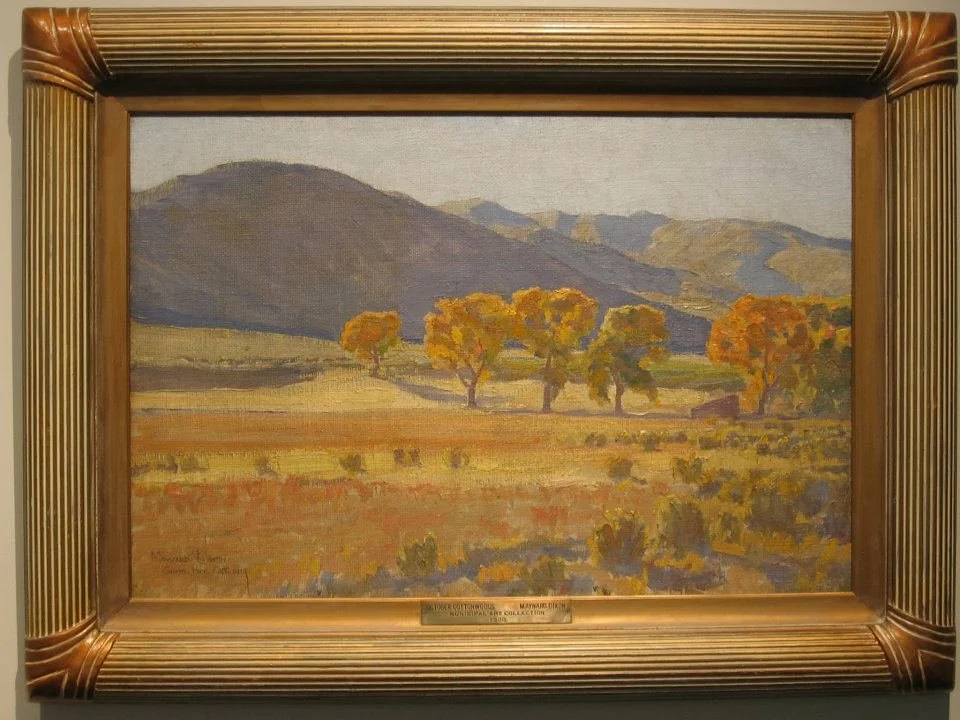
October Cottonwoods by Maynard Dixon, 1920. Photo by Donna Reiner
But the problem still remained. How to purchase a painting? The Woman’s Club already knew how to engage the public in its endeavors. The club coordinated with the local public schools for the elementary students to contribute a penny each. High school students were encouraged to give at least five cents and larger donations were solicited from the general public. The club estimated the cost of the painting they would purchase in 1915 would be between $50 to $1000 ($100 in 1915 would be valued at approximately $3,207.68 in 2025).
Having 13 works to select from, the club purchased “Egyptian Evening” by Carl Oscar Borg for $125. Cleverly, the Woman’s Club presented the bill to Mayor George U. Young and the Phoenix City Council, which agreed to pay. Except for 1918, the Woman’s Club continued this method of acquisition until 1931.
And thus, the Phoenix Municipal Art Collection grew one piece at a time. The women were eager to keep things going. The Kachina School of Art donated five paintings to the city as gifts in the early 1950s. Those paintings had been exhibited and won prizes at the annual Arizona State Fair. The latter part of the 20th Century and the early part of this century have seen photographs added to the collection, ceramics, and sculptures.
The ever-growing municipal art collection has approximately 1200 pieces that are portable. But then there are the permanent pieces that are referred to as the public art collection. You will find these in parks, as part of pedestrian bridges, select sidewalks, or even as part of freeway overpasses.
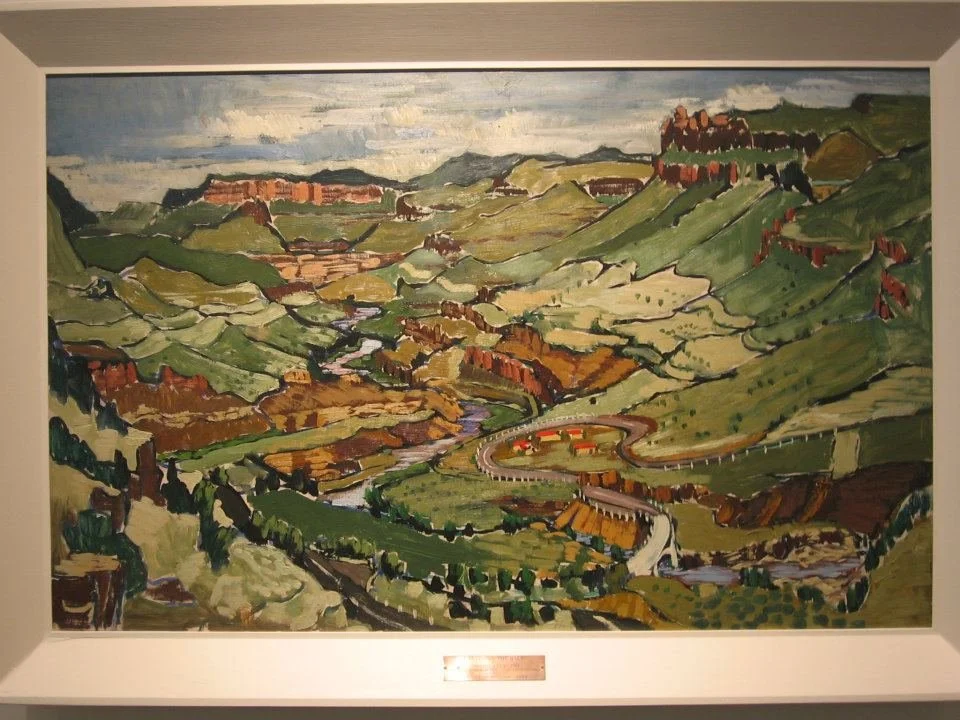
Canyon on the Salt by Dorothy Johnson Bergamo, 1952. A gift from the Kachina School of Art. Photo by Donna Reiner
I would be remiss if I didn’t mention the Phoenix Sky Harbor Airport Collection. While this is not included in the Municipal Art Collection, it is indeed spectacular. You have the opportunity to see permanent art pieces (check out the terrazzo floors in both terminals and the sky train stations), changing exhibits and now two galleries. The one in Terminal 4 is outside of the security area and the one in Terminal 3 is inside. I try to get to the airport early so I can check out the latest exhibit. But you will find cases on walls near the gate entries and free-standing cases near the ticket counters.
And even if you never rent a car at the airport, it’s worth taking the sky train there to see all the art including the Paul Coze mural that was originally designed for the former Terminal 2.
Definitely the Woman’s Club of Phoenix helped put Phoenix on the art map.
Donna Reiner is a board member of Preserve Phoenix and the co-author of three books on Phoenix history.