
There is no field where time passes more quickly than in Historic Preservation.
As a younger city, this is especially relevant in Phoenix where a diverse architectural record of buildings fluctuates greatly as new developments emerge. A structure can stand one moment and be gone the next, with a 30 to 60 day demolition hold that stands in the way of an eager property owner.
To be considered for historic status, a building or property must be considered under the following criteria, which is a site that is at least 50 years old, has cultural (as well as other) significance, and has architectural integrity of the era it was constructed.
Because of this first quality, local properties and structures continually age into potential historic status despite the range, which began in 1975 or earlier. Although they’re not the striking Victorian, Googie, or even International styles that dot the Valley, these Modern buildings are still worthy of consideration and protection by municipalities.
Read further for a list of highlighted structures and how their significance spoke to a time when Phoenix was in transition from one era to the next.
If you’re a property owner who wants to know more about preserving your historic structure, you can contact Preserve Phoenix here.
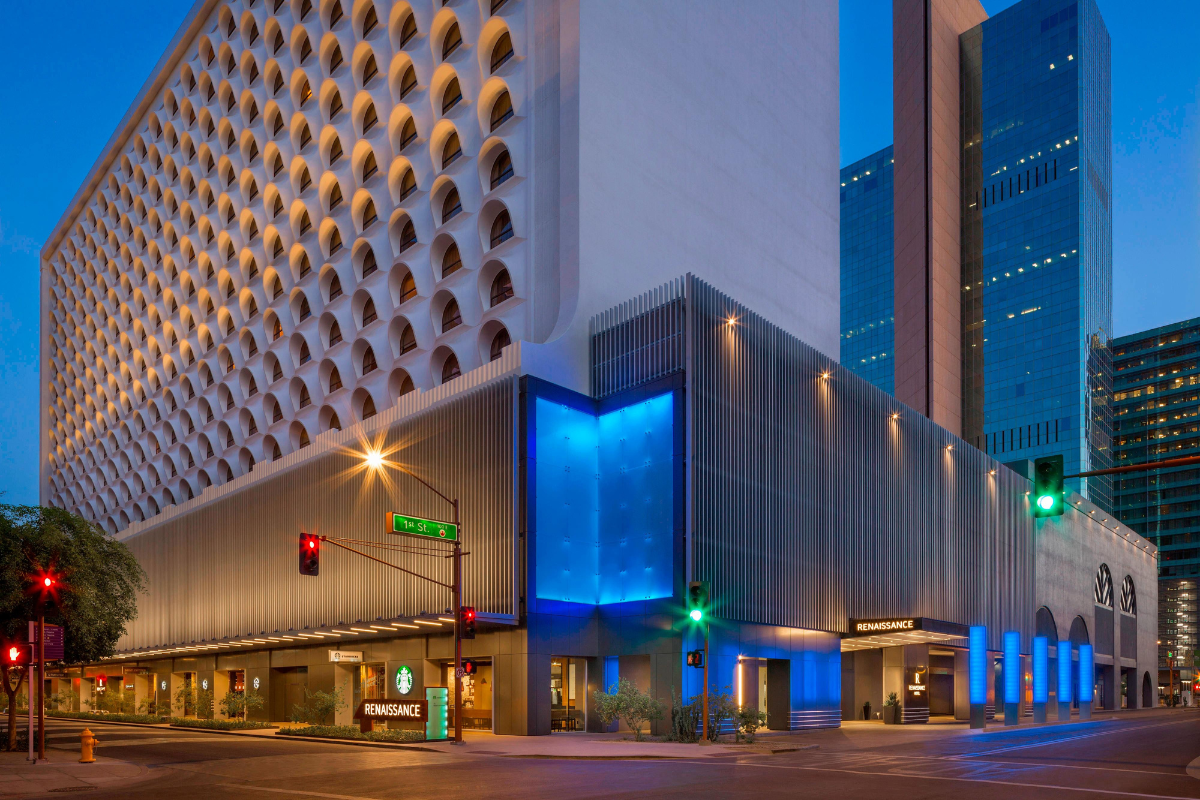
Renaissance Hotel, Phoenix Arizona
Renaissance / Adams Hotel (100 N. 1st Street) | Architect: Schwenn & Clark | Completed: 1975
Much of what defined the early Downtown Phoenix skyline involved 19-floors of pre-cast concrete on the Adams Hotel’s rectangular footprint. The openings in the concrete shade each arched window above the fifth floor against the hard Arizona sun.
These iconic arched ⅜ windows, which resemble eyelids, span both sides of the Renaissance Hotel are 12 ft. long and weigh 400 lbs, which cost $600 (or $4,350, when adjusted for inflation in 2025) to fabricate.
Schwenn & Clark, the firm responsible for the design of the hotel, integrated many arch shapes into the final design that invoke a previous construction of the hotel. Prior to a 2017 revamp, curved arches shaded arcade walkways on street level.
The site of the Renaissance Hotel has always been a hotel since the beginning. The prior hotel, built on the same footprint in 1911, was condemned and destroyed by controlled-demolition, on August 12, 1973. The construction of the Hotel, initially known as the “Rodeway Adams,” came at a pivotal moment when the city began to make Downtown competitive with other states to gain convention traffic.
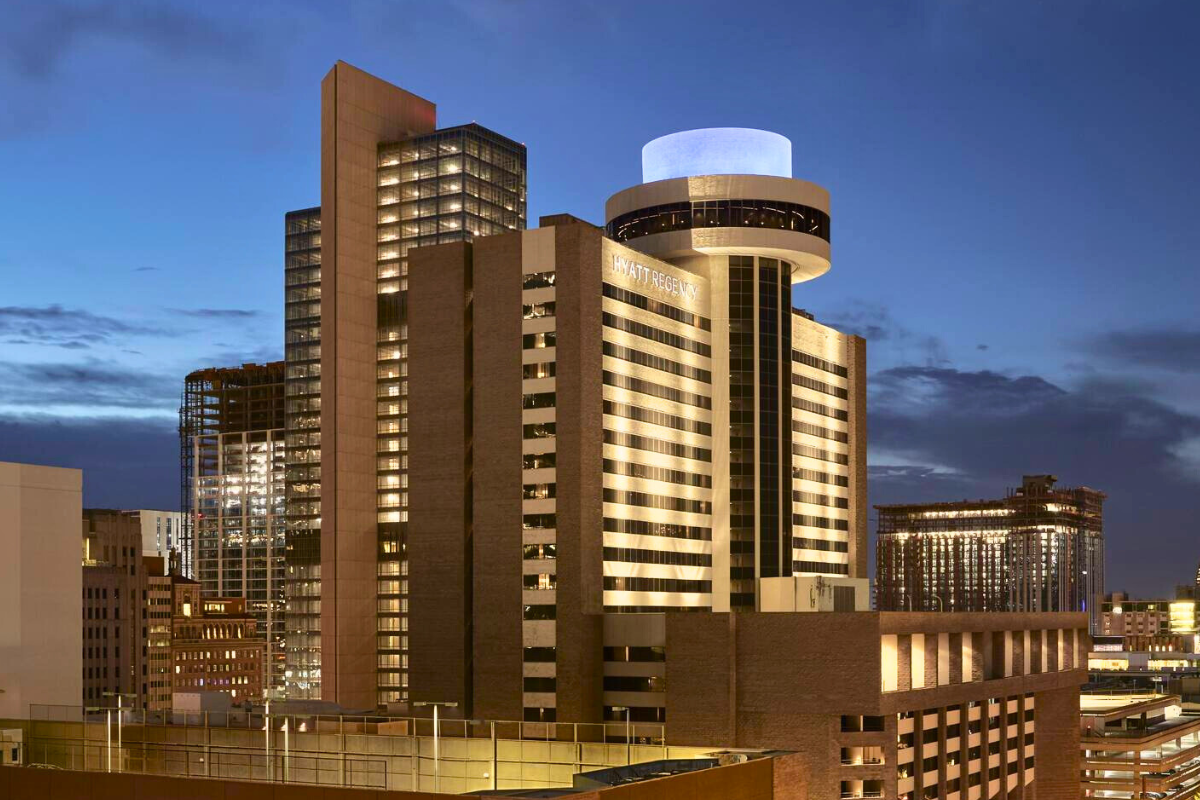
Hyatt Regency, Phoenix Arizona
Hyatt Regency (122 N. 2nd Street) | Architect: Charles Luckman and Associates | Completed: 1976
The Hyatt Regency opened in a frenzy at the dawn of 1976 to create demand for organizations to use Downtown Phoenix as a location to create convention traffic. At the time, Phoenix competed with multiple cities, including Las Vegas, Los Angeles, San Francisco, Seattle and Salt Lake City, to attract these conventions and trade shows.
The national convention of the American National Cattlemen’s Association became the first organization to utilize 600 of its 734-hotel rooms. With the construction came an expectation of additional economic traffic to the area: The hotel expected to generate 600 new workers to the Downtown community, and three large conventions booked for 1976 were estimated to bring in about $11 million (or $71 million, in 2025 dollars) into the local economic, according to a 1974 Arizona Republic article.
The Los Angeles-based Charles Luckman and Associates, which operated a satellite office in Phoenix, fully equipped the massive hotel’s interior with commercial shops, boutiques, cocktail lounges, and, of course, a striking revolving rooftop restaurant to service guests and the Downtown’s workforce alike.
The firm previously designed the Phoenix Convention Center, Symphony Hall and Civic Plaza (where the Convention Center’s West Building now stands), which greatly added walkability to the area.
Civic Plaza, with a sprawling plaza outside Symphony Hall that resembled Lincoln Center, and a connected Phoenix Convention Center, was seen as a lucrative selling point that necessitated adding updated hotels to the core.
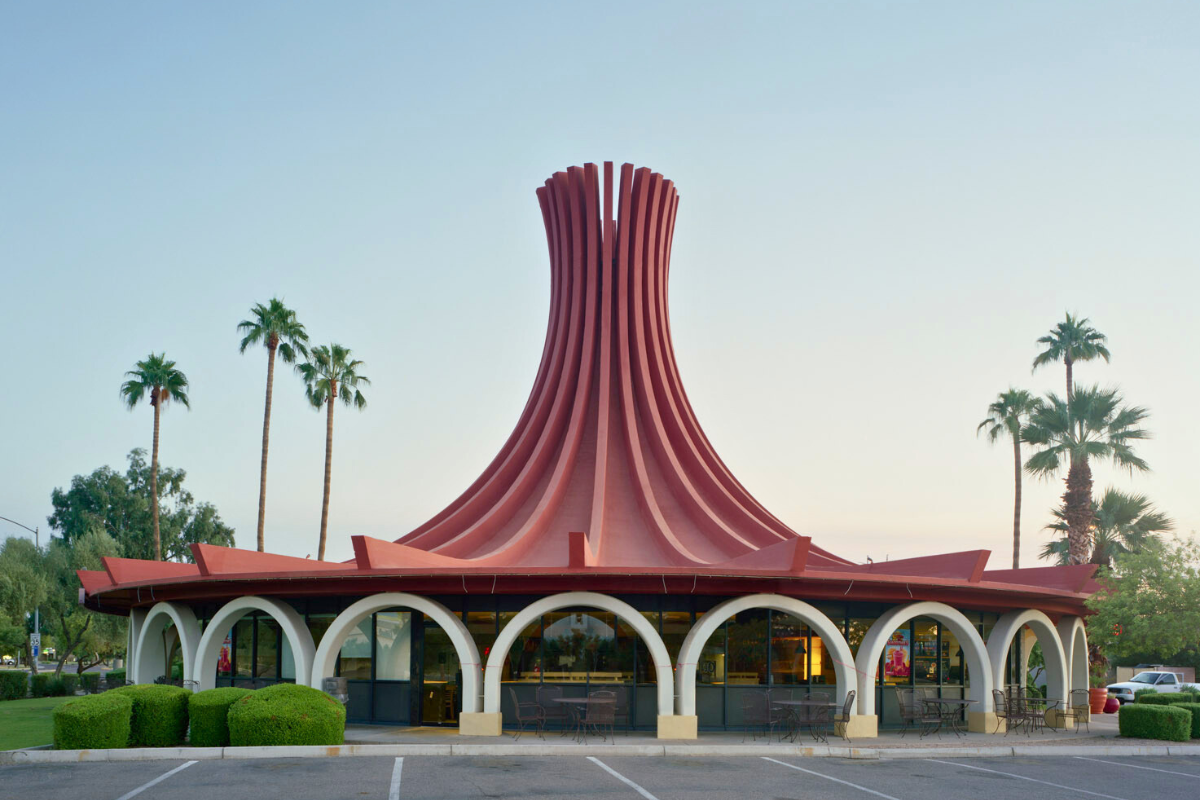
Western Savings Branch Bank - Photo Credit: Michael Lundgren
Western Savings Branch Bank (10005 N Metro Pkwy E) | Architect: W.A. Sarmiento | Completed: 1975
In Spring 1974, the newly opened Metrocenter Mall, which invested $100 million into developing the anchors of the Mall, planned to double the occupancy and revenue of the mall by adding businesses on the edge of its footprint. One such peripheral structure was the addition of a Western Savings Bank branch, one of 10 local branches at the time.
The higher elevation of the nearby I-17 freeway in relation to the mall necessitated a striking design. The architect on the project, Wenceslao Alfonso “W.A” Sarmiento, envisioned the latest bank branch to capture the attention of motorists with a rising roof design, which resembled the top of an onion bulb. Additionally, when customers stepped inside, stained-glass at the top of the roof design illuminated the inside of the bank. Details like the ground-level arches in front of the front windows further invited customers inside.
At a glance, the project took inspiration from Oscar Niemeyer’s Cathedral of Brasilia, where Sarmiento briefly worked at Niemeyer’s firm as a draftsman. Western Savings carefully selected the architects used on their expressive designs, who rehired Sarmiento after using him on their Phoenix Financial Center project in 1964.
Although the Western Savings branch eventually vacated, subsequent tenants, such as a soup and salad bar (“Souper! Salad!”) and a gun shop (“Tombstone Tactical”) have made Samiento’s circular design work to their favor.
Also Built 50 Years Ago:
Valley National Bank (2950 W Peoria Avenue) | Completed: 1974
Vlassis Ruzow & Associates (1545 W Thomas Road) | Completed: 1974
Arizona Bank / U.S Bank Building (101 N 1st Ave) | Completed: 1975
Our Lady of the Valley Catholic Church (3220 W Greenway Road) | Completed: 1976
The influx of development of these commercial buildings came at a time when multi-family residential housing tapered off, due to overdevelopment by out-of-state investors, coupled with a national recession.
When passengers fly into Sky Harbor International Airport now, the record of this specific moment in time is still mostly visible, from the revolving Compass Room atop of the Hyatt Regency to the Renaissance’s frontage, when a plane is on final approach.
And it is a testament how these timeless designs transcended passing fads.
Written by guest author, Taylor Costello.